Hiring developers in 2025
Hiring in IT was never easy.
Neither it is now, in 2025, but specifics change.
Practical stats
Recently, I had a software engineer role open. Out of 200 applications, 180 got rejected at the very start.
Out of 20 remaining, 17 failed the skill check: take home assignment and an interview.
Out of remaining 3, two got hired.
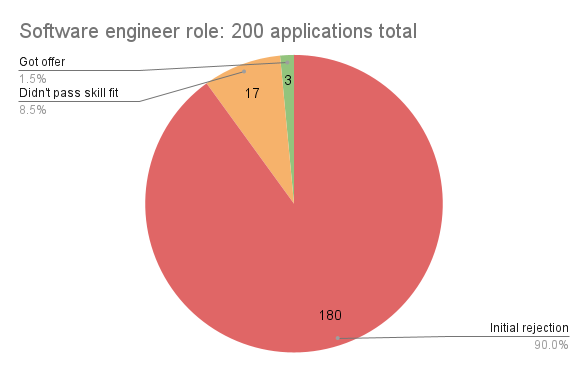
The primary learning here is that application quality is low. Only 10% of applications got past the initial stage.
Additionally, either expectations are high or applicants overestimate their skill, with 85% of those who made it to the skill fit stage failing it.
Looking at this example, if you blindly apply to position in software that is somewhat relevant, your chance of getting hired is 2/200, or 1%. Good luck with that.
If you apply to a relevant position, your chance is now 2/20, or 10%. (Technically it could have been 3/20, or 15%, but only 2 got hired.) Not excellent odds, but certainly worth trying.
What do ™️?
So how do you find those relevant positions and what do you do?
- Read the job ad. I am well aware that they all look alike. Filter out the information that is relevant and DECIDE if you fit. Apply if you think you have 80% fit.
- Do some research on what the company does. What are the possible challenges they can face? Why do they have this particular opening?
- Avoid recruiters applying on your behalf. That way you cost more for the company hiring you. Unless you're a niche professional who are hard to find, why pay extra and lower your chances?
Read tħe job äd
Suffice to say that job ads are messed up. Someone who applies AI to extract useful information out of job ads, or to translate their jargon into a human language is going to make a fortune.
The typical job ad looks like this:
- Your role and responsibility (either corporate blabber or a set of words that make sense separately but lose all meaning when packed together in a sentence, example:
Foster a culture of mentoring, innovation, and skill development across your team) - Requirements (often unverifiable and designed to act as a filter during later stages, example:
Excellent communication and interpersonal skills) - Stuff about diversity, equal opportunities, etc.
- Perks and benefits (salary range if you're lucky; vacation as perk if you're not lucky)
Don't fret and actually read the frigging ad. Look at must haves (you need to satisfy 80% of them), should haves (1 of those is enough), and look what the ad DOES NOT say.
If it does not say anything about compensation, then compensation is not a strong point.
If it does not say anything about tech stack, then the tech stack is likely legacy that has grown its own legacy.
You get the gist.
Do some research
Be able to answer the following questions:
- What is the company objective?
- How does this company measure its success?
- How can the tech architecture look like?
- What are the possible problems they deal with daily?
- [Huge bonus] How can you help them?
- [Huge bonus for you] Is your team/department a cost center?
Notice that only one of those questions is somewhat technical. The reason is simple: unless you're applying at a handful cutting edge shops, your work will be just like any other similar company and it won't matter which language, stack, cloud provider is used. So don't bother digging too deep.
For tech, the only thing you wanna make sure that tech does not stand in the way of business.
Avoid recruiters
There were times when a recruiter could help a lot: they could bring you relevant offers, and receive their commission from the company, not you.
These times are over for the common IT roles. Each time a recruiter contacts me saying they have a professional with 10 or more years of experience who's open atm, I wonder why doesn't the said professional just apply directly.
Summary
- Apply to a relevant role to increase your chances from marginal 1% to 10..15%
- Learn how to figure out if the role is relevant for you (summon your fav LLM here)
- Good luck. Don't get discouraged. Rejection always means "not now". You can and should try again.
